Skip to content

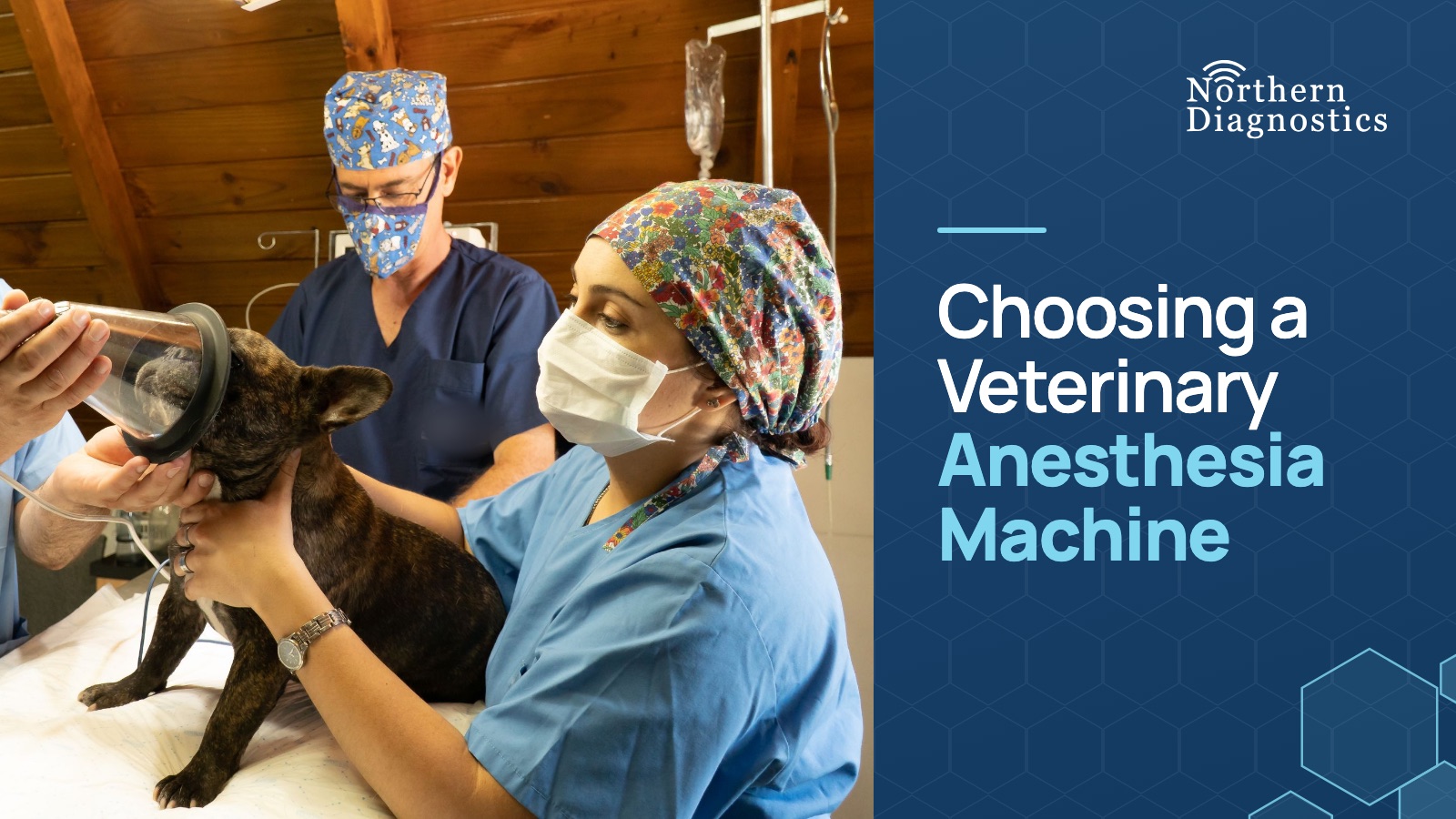











A veterinary anesthesia machine delivers a controlled mix of oxygen and inhalant anesthetic to the patient, and carries the waste gas away from your team. When you’re choosing one, the parts that decide how well it fits your practice are the vaporizer, the breathing circuits it supports, the ventilator, the scavenging, and how easily the whole machine can be checked before each patient.
Get those right for your caseload and most of the remaining differences come down to preference.
Key takeaways
- Match the vaporizer to the inhalant you actually use. Vaporizers are agent-specific.
- Make sure the machine works with both rebreathing and non-rebreathing circuits if you see small patients.
- A manometer and a safety pop-off valve in the breathing circuit are basic safety features, not extras.
- Decide whether you need an integrated ventilator now, or a machine that can be upgraded to one later.
- Ask who services the machine and the vaporizer, and where the parts come from.
What does a veterinary anesthesia machine actually do?
An anesthesia machine takes oxygen from a supply, measures it through a flowmeter, passes it through a vaporizer that adds a precise concentration of inhalant, and delivers the mix to the patient through a breathing circuit. Excess gas then leaves the circuit through the pop-off valve to a scavenging system rather than into the room.
The main parts you’ll be comparing are:
- Oxygen supply. Cylinders, a pipeline, or an oxygen concentrator, depending on how the clinic is set up.
- Flowmeter. Sets how much oxygen flows through the machine.
- Vaporizer. Adds the inhalant at the concentration you set. Each vaporizer is built for one agent, such as isoflurane or sevoflurane.
- Breathing circuit. Either a rebreathing (circle) system with a CO2 absorbent, or a non-rebreathing circuit.
- Adjustable pressure limiting (pop-off) valve, reservoir bag and manometer. These let the team control and see the pressure in the circuit.
- Scavenging. Removes waste anesthetic gas.
A useful way to learn any machine is the one the American Animal Hospital Association suggests in its 2020 anesthesia and monitoring guidelines: follow the oxygen from the source, through the machine and circuit to the patient, then back to the bag and on to the scavenging system.
Which features matter most when you’re comparing machines?
The features that matter most are the ones tied to your patients and your procedures. A practice seeing cats, small dogs and large breeds on the same day needs a different setup than a clinic doing mostly routine spays and neuters.
Here are the points worth comparing side by side:
- Vaporizer. It should match the inhalant you use. If you might switch agents in the future, ask what that would involve.
- Circuit compatibility. The AAHA guidelines note that non-rebreathing circuits are commonly used for cats and small dogs, roughly under 3 to 5 kg, while larger patients usually go on a rebreathing circuit. A machine that handles both covers more of your caseload.
- Safety features in the circuit. AAHA names two features every anesthetic machine should have: an in-circuit manometer and a safety pop-off valve.
- Ventilation. Manual breaths only, an integrated ventilator, or a machine that can take a ventilator later.
- Leak testing. Some machines run an automatic leak test, while others are checked by hand.
- Scavenging. AAHA describes active scavenging systems as far more effective than passive ones, such as activated charcoal canisters.
- Footprint. Cart-mounted, table-top or wall-mounted, depending on how your surgery suite and prep area are laid out.
It’s also worth thinking about monitoring at the same time. The anesthesia machine and the patient monitor are used together on every procedure, so it helps when the two fit the same space and workflow.
Do you need an integrated ventilator?
An integrated ventilator delivers breaths for the patient at the settings you choose, so a team member doesn’t have to hand-bag during a longer procedure. Clinics doing longer or more complex surgeries usually find it earns its place. A practice doing mostly short, routine procedures may manage without one for now.
If you’re not sure, a machine that can be upgraded later is a sensible middle ground. You buy for the caseload you have today without closing the door on the one you’re planning for.
How the ventilator is driven matters too. This is where two otherwise similar machines can differ in day-to-day running.
| Gas-driven ventilator | Turbine-driven ventilator | |
|---|---|---|
| What powers it | Compressed gas, usually oxygen or air, moves the bellows | An electric turbine generates the breath |
| Gas use | Uses drive gas in addition to the fresh gas going to the patient | No separate drive gas needed |
| What it relies on | A dependable compressed gas supply, plus power for its controls | A dependable power supply |
| Worth asking | How much drive gas it uses per hour at typical settings | How it behaves if power is interrupted |
Neither is automatically better. The right one depends on your gas supply, your caseload, and how the clinic is set up.
How often should the machine be checked and serviced?
The AAHA guidelines recommend leak testing the machine and the breathing circuit before anesthetizing each patient. The test is simple. With the pop-off valve closed and the end of the circuit blocked, oxygen flow raises the circuit pressure to 20 to 30 cm H2O, the oxygen is turned off, and the manometer should hold steady. If it doesn’t, the machine comes out of use until the leak is found.
Professional servicing is a separate job. The machine, the vaporizer and the ventilator each have a service schedule set by the manufacturer, and keeping to it is part of keeping the vaporizer accurate.
When you’re comparing suppliers, ask:
- Who services the machine and the vaporizer, and how often
- Whether parts are held in Canada or shipped in
- What happens to your surgery schedule if the machine needs repair
- Whether your team gets hands-on training on setup and the daily checks
What we supply for veterinary anesthesia
Northern Diagnostics supplies the Mindray Veta 3 and Veta 5 veterinary anesthesia machines. Both are turbine-driven, so they don’t need a separate drive gas, and both have an 8 inch touchscreen, an automatic leak test and apnea backup ventilation. The Veta 5 adds full ventilation with volume and pressure control modes. The Veta 3 can be upgraded to a Veta 5 later, which suits a practice that wants to start simpler and add those ventilation modes as its surgical caseload grows.
We also supply veterinary patient monitors and infusion pumps, so the anesthesia machine, the monitor and the pumps can all come from one supplier.
Frequently asked questions
What are the main parts of a veterinary anesthesia machine?
The main parts are the oxygen supply, the flowmeter, an agent-specific vaporizer, the breathing circuit (rebreathing or non-rebreathing), the pop-off valve, the reservoir bag, the manometer and the scavenging system. Many machines also have an integrated ventilator.
How do you leak test a veterinary anesthesia machine?
Close the pop-off valve, block the patient end of the breathing circuit, and use oxygen flow to raise the pressure to 20 to 30 cm H2O on the manometer. Turn the oxygen off. The pressure should hold steady. If it holds, open the pop-off valve first, then unblock the circuit. The AAHA guidelines recommend doing this before each patient. Always follow your machine’s own documented procedure too.
Can one vaporizer be used for both isoflurane and sevoflurane?
No. Vaporizers are agent-specific, so each one is built and calibrated for a single inhalant. A clinic using both agents needs a vaporizer for each.
Is a turbine-driven ventilator better than a gas-driven one?
Not automatically. A turbine-driven ventilator doesn’t use a separate drive gas, while a gas-driven ventilator does. Which one suits you depends on your gas supply, your power supply and your caseload.
Planning a new anesthesia setup?
If you’re replacing an older machine or setting up a new surgery suite, we would be happy to talk through what fits your caseload. You can see our veterinary anesthesia machines, or get in touch with our team.