










When clinics compare ultrasound systems, most of the attention naturally goes to the machine. But the transducers you choose can be just as important.
The probe determines the frequencies, depths and anatomy you can effectively image. Two clinics can use the same ultrasound system for completely different applications simply because they have different transducer configurations.
Probes can also represent a significant part of the cost of an ultrasound package, so choosing the right combination from the beginning matters.
Here are the main ultrasound probe types, what they are designed to do, and how to determine which ones your practice actually needs.
Key takeaways
- Linear, curvilinear, phased array and endocavity transducers cover many of the applications encountered in clinical ultrasound.
- One of the fundamental trade-offs in ultrasound is frequency versus penetration: higher frequencies generally provide better resolution at shallow depths, while lower frequencies penetrate deeper.
- Linear transducers are commonly used for superficial applications such as MSK, vascular and small parts.
- Curvilinear transducers are commonly used for abdominal and obstetric imaging where greater depth and a wider field of view are required.
- The right probe package should be built around the examinations you actually perform, not simply whatever is included in the standard configuration.
The principle behind ultrasound probe selection
One of the most important concepts when choosing a transducer is the relationship between frequency and penetration.
Higher ultrasound frequencies generally provide better spatial resolution but do not penetrate as deeply into tissue. Lower frequencies provide greater penetration at the expense of some resolution.
That means the “best” probe depends on what you are trying to see.
A superficial tendon, a carotid artery and a deep abdominal organ have very different imaging requirements. The transducer needs to match the anatomy, depth and patient population.
Once you know what you are scanning, choosing the appropriate probe becomes much easier.
Linear probes
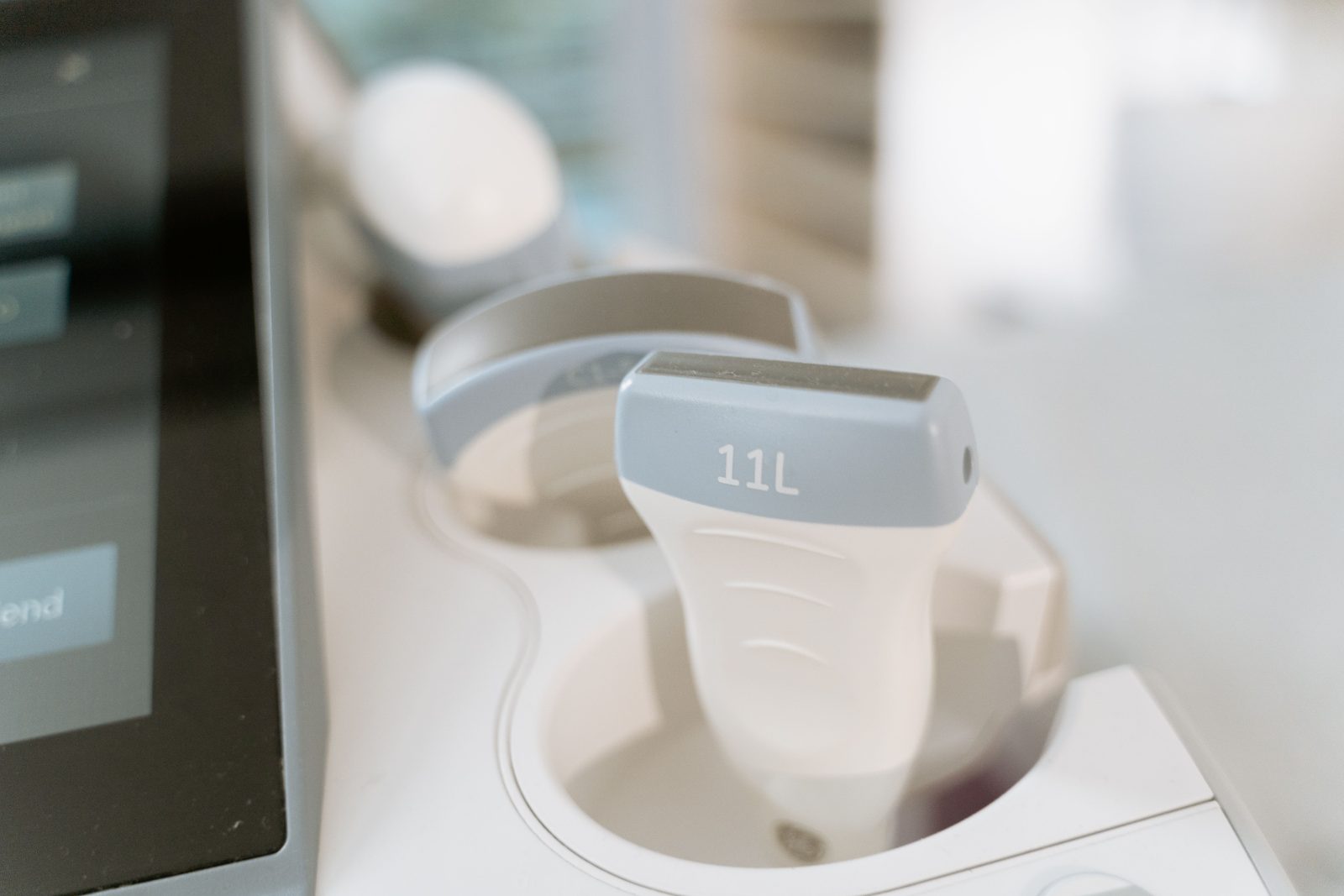
A linear transducer has a flat footprint and typically produces a rectangular image.
Linear probes generally operate at higher frequencies and are designed for structures relatively close to the skin.
Common applications include:
- Musculoskeletal imaging
- Vascular imaging and vascular access
- Thyroid
- Breast
- Small parts
- Superficial nerves and soft tissue
- Ultrasound-guided procedures
For an MSK or sports medicine practice, the linear transducer is often the workhorse.
But not every linear probe is the same. A very high-frequency linear transducer may provide excellent detail for superficial tendons, nerves, fingers and other small structures, while a lower-frequency linear transducer may provide the additional penetration needed for deeper anatomy or larger patients.
That is why looking at the word “linear” on a quote is not enough. Look at the frequency range, footprint and intended applications as well.
Curvilinear probes
A curvilinear — or convex — transducer has a curved footprint and produces an image that widens with depth.
These transducers generally operate at lower frequencies than superficial linear probes, providing the penetration required for deeper anatomy.
Common applications include:
- Abdominal imaging
- Obstetrics
- Gynaecology
- General imaging
- Selected point-of-care ultrasound applications
For many general imaging applications, the curvilinear transducer is one of the most versatile probes available.
The wider field of view at depth is particularly useful when evaluating larger organs and deeper anatomy.
As with linear probes, frequency ranges vary considerably between models. The right curvilinear transducer depends on the patient population and examinations being performed.
Phased array probes
A phased array transducer has a relatively small footprint and produces a sector-shaped image from a narrow acoustic window.
That small footprint is particularly useful when scanning between the ribs, which is why phased array transducers are strongly associated with cardiac imaging.
Common applications include:
- Echocardiography
- Cardiac point-of-care ultrasound
- Selected emergency and critical-care examinations
- Other applications requiring access through a small acoustic window
The combination of a small footprint and relatively low operating frequencies allows the transducer to image deeper structures through limited acoustic windows.
If cardiac or point-of-care imaging is part of your practice, the phased array options available on a system should be considered when comparing equipment.
Endocavity probes
Endocavity transducers are designed for internal examinations, most commonly transvaginal or transrectal imaging.
Because the transducer can be positioned much closer to the anatomy being evaluated, it can use frequencies that provide greater detail than would typically be possible when imaging the same anatomy externally.
Common applications include:
- Gynaecology
- Early obstetric imaging
- Fertility and reproductive medicine
- Selected urological and prostate applications
For a women’s health practice performing both transabdominal and transvaginal imaging, a curvilinear and endocavity transducer are a common combination.
Probe selection for these applications should also take cleaning, disinfection and infection-control requirements into account.
What about microconvex and other specialty probes?
The four categories above cover many clinical applications, but they are not the only transducers available.
A microconvex transducer, for example, combines a smaller curved footprint with a relatively wide field of view. Depending on the transducer and system, it can be useful in applications where access is limited but deeper penetration is still required.
There are also specialty transducers designed for applications such as transesophageal echocardiography, intraoperative imaging and other specific examinations.
The important point is that probe names describe the design, not everything the probe can do.
Always look at the specific transducer’s frequency range, footprint, supported applications and compatibility with the ultrasound system.
How many probes does a clinic actually need?
There is not one correct number.
A focused practice may do everything it needs with one transducer. A multidisciplinary imaging clinic may require several.
As a starting point, configurations often look something like this:
| Practice | Common starting configuration |
|---|---|
| MSK / sports medicine | High-frequency linear |
| General imaging | Curvilinear + linear |
| Women’s health | Curvilinear + endocavity |
| Cardiology | Phased array |
| Emergency / POCUS | Linear + phased array and/or curvilinear |
| Mixed veterinary | Often linear + curvilinear/microconvex, depending on species and applications |
These are not rules. They are starting points.
The better approach is to list the examinations your clinic expects to perform and make sure every necessary application is covered.
Buying additional probes “just in case” can add thousands of dollars to a package without adding much practical value.
The opposite can be just as problematic. Removing a transducer that is genuinely required to make the initial quote more attractive can leave you with a system that does not properly cover the applications you bought it for.
If you are working through this as part of a wider purchase, our guide to buying an ultrasound system in Canada covers the rest of the decision.
Do not compare probes by frequency alone
Frequency is important, but it is not the only factor that determines how useful a transducer will be.
When comparing probes, consider:
- Frequency range
- Penetration
- Footprint and access to the anatomy
- Field of view
- Ergonomics and weight
- Patient population
- Supported imaging modes and applications
- Compatibility with the ultrasound system
And whenever possible, scan with the probe before you buy it.
Specifications can narrow the shortlist, but actually using the transducer on the types of examinations you perform will tell you much more. You can see the range we supply on our probes and transducers page.
Looking after the probes you already have
Ultrasound transducers are one of the most frequently handled, and potentially expensive, components of the system.
Good handling practices can help reduce unnecessary damage:
- Return probes to their holders when they are not being used
- Keep cables away from wheels and other pinch points
- Avoid excessive pulling, twisting or bending at the strain relief
- Do not wrap cables tightly around the transducer
- Follow the manufacturer’s approved cleaning and disinfection instructions
- Regularly inspect the lens, housing, cable and strain relief for visible damage
Probe problems can present in different ways, including intermittent image dropout, artifacts or changes in image quality.
If an image problem appears when the cable or strain relief is moved, the transducer is one of the components worth investigating before assuming the ultrasound system itself is failing.
Depending on the type and extent of the damage, probe repair may also be possible, potentially avoiding the cost of immediate replacement.
Frequently asked questions
What is the difference between a linear and curvilinear probe?
A linear transducer has a flat footprint and is generally used at higher frequencies for superficial structures. A curvilinear transducer has a curved footprint, provides a wider field of view with depth and is commonly used at lower frequencies for deeper anatomy such as the abdomen.
The right choice depends primarily on the anatomy and depth you are trying to image.
Can one ultrasound probe do everything?
Not effectively.
Ultrasound transducers are optimised for different combinations of frequency, penetration, footprint and field of view.
A probe designed to provide excellent detail in a superficial tendon is not necessarily the right transducer for a deep abdominal examination.
Some focused practices can work with one transducer, while practices covering multiple applications will generally need more.
Are ultrasound probes interchangeable between machines?
Not necessarily.
Transducers are designed for specific ultrasound platforms and connectors. A probe from one manufacturer generally will not work on another manufacturer’s system, and compatibility can also vary between systems from the same manufacturer.
Always confirm the exact transducer model and system compatibility before purchasing a probe separately.
How long should an ultrasound probe last?
There is no universal lifespan.
Probe life depends on the type of transducer, frequency of use, handling, storage, cleaning and disinfection practices, and the clinical environment.
Regular inspection and proper handling can help identify damage early and extend the useful life of the transducer.
Is a higher-frequency ultrasound probe always better?
No.
Higher frequency generally provides better resolution at shallow depths, but penetration decreases as frequency increases.
The goal is not to buy the highest-frequency probe available. It is to choose a frequency range appropriate for the anatomy and depth you are imaging.
Start with the exams, not the equipment
If you are choosing an ultrasound system, write down the examinations you expect to perform before deciding which probes to buy.
- What are you scanning?
- How deep is the anatomy?
- What types of patients are you scanning?
- Which procedures do you perform?
- Which applications make up most of your workload?
Those answers tell you much more than a standard probe package does.
At Northern Diagnostics, we build ultrasound configurations around the applications a clinic actually performs. Get in touch and we will go through your requirements and recommend the appropriate transducers — including when that means fewer probes than you expected.